What the Airport is planning
Bristol Airport has submitted a planning application to increase its capacity from 12 million passengers per annum (mppa) to 15 million. This will allow the Airport to meet local demand, which is expected to reach 15 million by the late 2030s.
New infrastructure is required for Bristol Airport to reach 15mppa, which will mean substantial changes to the operation of the Airport. We can expect new destinations, new airlines, and new aircraft in the years ahead.
North Somerset Council is running a consultation until 28th June – you can comment on that here.
New infrastructure
Depending if and when planning permission is granted, Bristol Airport is expected to start work this decade. Their 15mppa project would deliver:
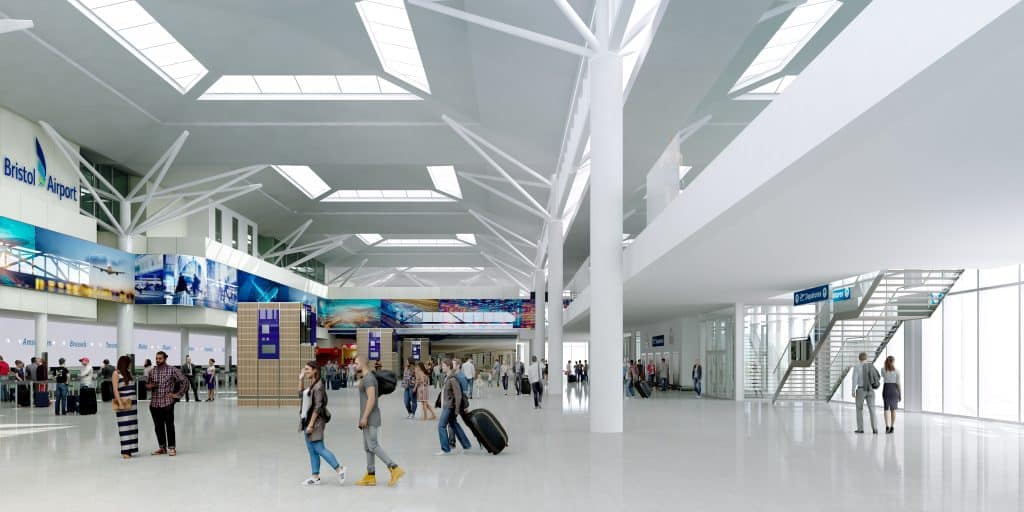
- A larger terminal with more space, more shops and restaurants. A bigger immigration hall and baggage handling facilities.
- Runway and taxiway improvements incorporating changes to approach lights to allow for larger ‘Code E’ aircraft to connect the region directly with a limited number of long-haul destinations. 170 metres of runway would be added to east with additional length being provided by moving the touchdown zone.
- New lounges and jet bridges to serve these Code E aircraft.
- A larger and reconfigured apron. Virtually all stands will be contact stands, removing the need for passengers to be bussed to/from the terminal. The plans include two piers, connected to the main terminal via a tunnel.
- Customer improvements including travelators to help passengers get to their gates.
- Highway improvements on the A38, and a new bus lane making travel more reliable between the north and south side. Public transport investment would mean 1 in 4 passengers access the site by bus or coach.
- Expanded car hire facility – to serve the increase in inbound visitors and business travellers.
- A maintenance hangar – creating high-skill jobs and preventing the need for aircraft based at Bristol Airport to fly elsewhere for maintenance.
Aircraft movements would increase from 85,990 to 99,931 per year in the longer term. On a busy day in peak period this would result in 35 extra aircraft movements.
Video Walkthrough
What new aircraft and routes could we see?
Bristol Airport is targeting new direct routes to North America and the Middle East. The upgraded infrastructure and longer runway would enable the Airport to more easily host ‘Code E’ aircraft, which include Boeing 777s and 787s, and Airbus A330s and A350s. Emirates, for example, use the Boeing 777-300ER on flights to other UK regional airports.
We can also expect to see the A321neo XLR and Boeing 737 MAX 8 begin to make an appearance at the Airport, serving longer routes.
Bristol Airport does host TUI’s Boeing 787 Dreamliners occasionally now, taking people to cruises in the Caribbean. Until 2005, there was a link to New York using Continental’s Boeing 757-200. However, the current short runway (2,011 metres) presents operational challenges, restricting opportunities for long-haul routes.
The Airport will continue to try and attract new airlines for short haul routes, and we can expect the established companies to expand their network.
Timescales
North Somerset Council is running a consultation until 28th June – you can respond to that here: https://planning.n-somerset.gov.uk/online-applications/applicationDetails.do?activeTab=neighbourComments&keyVal=TCIP27LP01600
A decision by North Somerset Council’s planning committee is expected towards the end of the year.
If successful, the Airport would continue to expand in increments, as it has done in the past. Development would depend on demand levels, but the £500 million of investment is likely to begin this decade.
More information is available on the Airport’s website: https://www.bristolairport.co.uk/corporate/about-us/our-future/plans-to-grow/